Introduction
I currently work at Bow Valley College, an educational institution that creates instructional material for a variety of learners and for an array of program areas. This instructional content is delivered in various formats such as face-to-face (traditional classroom setting), blended technology, and on-line learning (in both facilitated and in self-directed environments). Bow Valley College’s learners come from extremely diverse backgrounds and therefore have very different learning needs. The college attempts to adapt its curriculum to all types of learners and delivery methods. However, with the limited staff available, such a large-scale task is difficult to accomplish. My model has been design with my work environment in mind.
During the creation of the instructional design (ID) model I realized that I wanted a generic model that could be flexible and adaptable enough to address the diversity of content and delivery (face-to-face or an on-line environment) for various instructional situations. Following are the three phases that depict the evolution of the model.
Model Explanation and Rationale
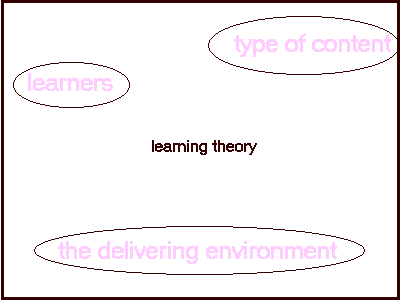
Phase one of my model includes the basic 'building blocks' of any instructional design model. These following components are the first pieces of information an instructional designer needs to take into consideration when designing instruction.
When I started to think about my instructional design model, I wanted to approach it in new way (I wanted to reevaluate my own idea of what is an ID model). I wanted to start from scratch... and from there, I wanted to incorporate new pieces (building blocks) to my model as I would find them necessary. So this is the first phase, the start my model.
Here's a pictorial of my phase one.
Journal Entries
At my work (BVC) we design and develop material for learners and since I've been working there (almost 2 years), I've becoming more and more aware of what is involved in the design of instruction at a larger scale. Before, I was a teacher for a few years but didn't find that I had a good grasp on any ID model in particular. Now, I'm interested in finding a model that would suit my needs, one that I will be comfortable in using while teaching or while developing new curriculum material. A model that would make sense to me, not just in term of knowledge of the model, but also with the application of the model. I intend to become an instructional designer in the near future so I want to have a good grasp on ID models and how they are applied. At my current work, we are said to be using the Dick and Carey model but I don't see the process involved. I rather see what doesn't seem to be done...
As I'm thinking of a model to build, I want to be able to use my model with more than one learning theory. At this point I'm thinking Constructivism and Behaviorist. I want my model to be flexible and generic enough that I can adapt it to different types of context.
Conversation
I met with Brad (my partner) and we discussed the project. We were not too sure what the project would turn out to be. So, we discussed 'models' in general to try to figure what each of us were thinking about what a model is.
Brad thought that: a model should incorporate:
So, a model would be somewhat prescriptive in that in a given set of circumstances (learner, theory, content, etc.), a certain type of instructional approach would be suggested with a given set of delivery criteria. (Brad)
My general thought was: There are many models out there and each model may have a different focus or emphasis. My own basic question was: What is necessary in a model? What do I need to look at during the process of creating instruction and material? I also thought that different models can be used for different purposes and/or focus. I thought that at least three major components need to be included for any ID model and it is: the learners, the content of instruction and the environment where the instruction will be delivered. And I also thought that learning theories were important in the delivery of the instructional material.
Summary of the revision
At first, when I started my model, I asked myself what do I need to look at when I design instruction. It was obvious to me that I had to look at the learners, the environment, and the content to be taught. As I go back and look at phase one of my model, I realize that the pieces I have included in my model are in fact the components for a 'needs assessment.' Interesting. So far, my model includes analysis question only. This brought to mind the idea that these components are the starting point, the first step of any instructional design; the data collection to build on.
I also knew I had to take into consideration the learning theories but really, wasn't sure where to fit it in my model. So being in the middle of the learners, the environment and the content seemed appropriate at the time.

Model explanation and rational
This is the second phase of my model building. The model has the following four categories:
Needs assessment
The needs assessment is the first step in the model. It includes:
Analysis of each of these will collect data that will feed into the next step of the model—the design.
Building - thinking part -design
The second step in my model is the thinking part of the 'building.' In this section I included:
After collecting the data for the basic building blocks (learners, the environment and the content), the next step is to decide what leaning theory to use, then choose which instructional strategies will be appropriate to support the theory. Then after, comes a look at the resources and constraints of the instructional situation and finally the planning about the delivery method and media selection.
Building- doing part -development
The third step in my model is the doing part of the 'building.' In this section I included:
Knowing the learning theory direct you in the writing of the objectives and the learning outcomes. The creation of instructional material and activities comes before the creation of assessment in my model.
Evaluation
At this point I have two types of different types of evaluation that I feel are important to look at when designing material for an on-line environment.
Both types of evaluation have a formative and sumative component.
Learning System
I see my model as a learning system (Smith & Ragan, 1993) in which each part is interdependent of the others. It is a cyclical model where the analysis is the beginning and the evaluation the ending. It repeats this circular cycle to refine the instruction, and the learning system.
Journal
Note: Lots of these notes were just jotted down on corners of paper.
-I'm trying to figure out 'when' and 'where' in the model I should refer to the learning theories for the creation of instruction. The discussion with Brad helped me to decide where to put in a more appropriate location on the model —I moved it in the 'thinking' part of my model.
-I found an excellent Web site The Instructional Systems Process posted in message no. 155 in WebCT by Brigitte Vivianne Lepine (blepine) on Wed Feb 27, 2002 08:48. I realized that phase one of my model only includes the needs assessment portion of a model. This Web site was an interesting reference during the building of my model. I went often to explore different sections.
-So now I'm trying to figure out 'all the pieces' that should be considered in a instructional design model.
-As I'm reflecting on constraints and resources, I am remembering that, when developing material (for a course or programs), we need to find a balance between these three components: cost, time and quality.
-I've been having trouble to get a grasp on the types of content, the learning theory, and the instructional strategy. I know they work together, but I'm not sure yet how they are linked.
Conversation with Brad
At the beginning of phase two, I had a discussion with Brad regarding learning theories and ID model and where we should be inserting the learning theories in our models. At that point I knew learning theories were important in the design of instruction, but I couldn't see clearly where to put them in my model. The discussion with Brad helped to precise what I should be doing with the 'learning theories,' but also it also reminded me of the whole picture in a model. After that, I sketch the rest of the steps in my model.
In another conversation with Brad we were discussing how, depending of the learning theory used, the instructional strategy (method) will most likely be quite different and so will be the learning activities following each method. That's a point I find very interesting and fell I need to know much more about it. I'm interest in the instructional strategies and how they can be implemented in an on-line environment.
Summary of Model Revision
My model has expanded since phase one. It is now more complete. I have had time to think about some necessary pieces I needed to include to have a more complete cycle in my model. In phase two, there's a more complete version of the model. In phase one, you only saw the visual representation of the needs assessment (analysis) of the model.
The cycle starts at the analysis and 'theoretically' finishes at the evaluation. However, the model is not to be applied in a linear fashion but with a cyclical process in which revision is always present and part of the process.
I'm trying to create a generic model that I will be able to use to design face-to-face as well as on-line instruction. I want a generic model that can be adapted to various contexts of learning.
Visual Model
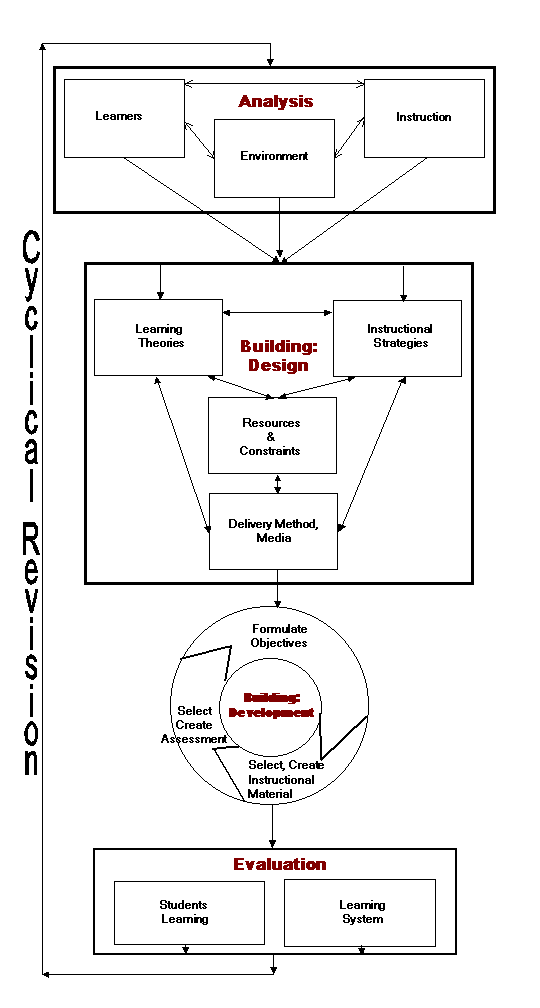
The picture of phase three is quite different visually than its predecesor phase two. However, my intent is the same. This pictorial is an expansion of phase two but presented in a more linear fashion. I chose to present my model in this linear fashion to better be able to play with the model and work on expanding it eventualy. I also wanted to visually describe the relationship between the components.
Description of Each Part
This model is seen as a learning system that operates in a cyclical manner and in which all parts relate closely to each other. Here are the four major building blocks of the model: Analysis, Building: Design, Building: Development, and Evaluation.
Analysis (Needs Assessment)
The data of these three components feeds into the building-design section.
Building: Design
Building: Development
Evaluation
Model Rationale/Evolution/Reflection
My model has changed a lot in each of its phases. I remove the learning theory from its original place in phase one and put it under the thinking building block in phase two. In phase two the model became more focused and more complete.
Personal Relevance
I had great interest in developing this model. One of my professional goals is to become an instructional designer so I found this exercise very relevant to me. At this point I am interested more in the designing block of the model and in the analysis. That's probably why these sections are more developed. I was also interested in the construction of a generic model that could be adapted depending on the various delivery setting (face-to-face to on-line) used.
Limitations of the Model
This model is not finished. It's in development, it hasn't be tested. I would have liked to explore further the areas of the instructional strategies and learning theories and how to build on these to develop instruction that fits the intent. Also, it would need to be tested with different learning theories to see how flexible and adaptable it can be. Some development is still needed in the 'development' block. It needs to be explored further.
I'm starting to see that the learning theory used in a model may well depend on the type of content used (fact, concept, procedure, principle and rules, interpersonal, and attitude) and the learning outcome needed.
Not all types of content (cognitive, psychomotor and affective domain) transfer well to an on-line delivery. In some case face-to-face will still be the best way to deliver the instruction.
Conclusion
The creation of this model was an interesting exercise. It really helped me to focus on what I thought is important when I want to create instructional material for various environments. I wanted to have a generic model I could use to work with different learning environments. I don't consider my model to be finised yet. I will need to refine it, as I design instructional material, and test it to see how useful and accurate it can be for me.
References
Shambaugh, N. R. & Maliaro, S. G. (1997). Mastering the possibilities: A process approach to instructional design. Needham Heights, Massachusetts: Allyn and Bacon.
Smith, P.L. & Ragan, T. J. (1993). Instructional Design. Chapter 2, Instructional analysis: Analyzing the learning context. pp. 25-41. New York: Merrill.
On-line References
Citation Style Guides for Internet and Electronic Sources. (2002). Electronic references. Retrieved April 14, 2002, from http://www.library.ualberta.ca/guides/citation/index.cfm
Bibliography
Shambaugh, N. R. & Maliaro, S. G. (1997). Mastering the possibilities: A process approach to instructional design. Needham Heights, Massachusetts: Allyn and Bacon.
Package of readings prepared for EDER 673 by Elizabeth Child. (version Fall 2000).
On-line Bibliography
Instructional Design Methodologies And Techniques at http://www.student.seas.gwu.edu/~tlooms/ISD/isd_homepage.html
Instructional Methods and Pedagogy First at http://clla.tamu.edu/IT/EdTech/pedagogy.html
Scott's Library: Educational Research Room. (2002). Instructional Theory and Design Resources. From http://kerlins.net/scott/instructheory.html
The Instructional Systems Process at http://www.personal.psu.edu/staff/s/m/smc258/KB/index.html
University of Colorado at Denver School of Education. (2002). Instructional Design Models. From http://carbon.cudenver.edu/~mryder/itc_data/idmodels.html