Constructivist Pedagogy
in the Virtual World
~ An Interpretive Essay~
(printable
copy)
Submitted in partial requirement
for the Degree of Masters of Education
in Educational Technology
Accompanied by an electronic portfolio
http://www.bbwebmedia.com/brisite/portfolio/
Presented by
Brigitte Lépine
February 2006
A printable copy of this document can be found here.
You will find on this right column below, some papers, websites, etc. that are related to the topic discussed in this essay.
Background and Interest
Master in Educational technology: Distance Delivery
Other Projects Involvement
ReferencesWhat is Constructivism?
Rubric Development
Rubric Testing: Results and Interpretation
General Overview
Environment/Context
Facilitation
Theory Pedagogy
Summary
This essay is a synthesis of my learning during my Master's program. There are many topics of interest I could have chosen to discuss in this essay but I finally decided to focus on the topic of constructivist pedagogy in the virtual world.
Is constructivist pedagogy the only good pedagogy for online learning?
Not at all! Nonetheless, in this essay, I will focus exclusively on the
constructivist pedagogical framework. My main reason is that I wanted
to become more knowledgeable about constructivism and its application
to the virtual world. I wanted to be able to recognize what a constructivist
approach looked like. So, this essay is exploratory research about constructivist
pedagogy in the virtual world.
To begin, I will disclose information about myself such as my background
and my interests. Then, I will move to the core of the essay, which is
about exploring what constructivism is, developing a constructivist rubric,
and applying the rubric. The essay ends with a discussion and conclusion.
Born French Canadian, I graduated in 1995 from the University of Calgary with a B.Ed majoring in French and a minor in Computers In Education. Following convocation, I taught in the French Immersion program (elementary level) for a few years in both the Catholic and public system. During my elementary teaching experience, it was my minor in Computers In Education that stimulated most of my interest. Each year I taught, I became more involved with technology. I became the 'technology specialist' at most schools where I worked. I tried to foster the technology integration movement at the school and district level because I liked technology! In my last school, I became the chairperson of the technology committee. As chairperson conscious of the new Information and Communication Technology curriculum, I tried to integrate technology, teaching, and learning. This was not an easy task!
After a few years of dedication and commitment, I became incredibly dissatisfied with the whole technology integration movement in the school system. Because I was interested in technology, I found myself responsible for maintaining technology for everybody! It turned out that I created additional work for myself with no additional support or compensation. This was a "gloomy" picture, to say the least and a turning point for me!
I was originally interested in using computer technology, not fighting with it as unfortunately happened too often in the early 90s. This build-up of dissatisfaction helped me change focus. I decided it was time to go back to university where I embarked on a Master's degree in Educational Technology.
Master in Educational technology
My area of specialization is Educational Technology, which is offered by the Graduate Division of Educational Research in the Faculty of Education at the University of Calgary.
When I started my program, I had the choice to complete my studies face-to-face or through online distance delivery. I chose to study online for two reasons. First was for the flexibility it seemed to offer, and second was because I wanted to experience 'online learning' myself, as a learner. I thought this would be a great opportunity for me, as I was interested in becoming an instructional designer (ID) for online delivery.
For the duration of my program, I was exposed to different teaching styles
located in different pedagogical frameworks. I had the opportunity to
experience different content delivery and communication tools such as
First Class, WebCT, Audio conference, Centra, Blackboard, and V-Class
(now Elluminate). It got me excited about online learning.
While completing my Masters of Education degree, I was involved in several research projects. I researched a collection of online resources related to research methods and research designs. I interviewed French teachers regarding their best practices in relation to technology integration in schools. I even had the opportunity to participate in the design and development of online courses. I was also able to contribute to Garrison, Anderson and Archer's (2000) work on their Community of Inquiry Model by completing content analyses of asynchronous online text-based discussions using their model. These were all very interesting experiences! To find more about these projects, visit the research section and work section in my portfolio.
Reflecting back, I find it interesting that the research and work projects I've been involved in have significantly shaped my thinking, especially in terms of pedagogical frameworks for the online environment. I see, however, that my interest was, and still is, focusing on pedagogy (teaching/learning) and technology.
This was an overview of my background, interests, and other related involvements.
The next section is about my journey into 'constructivism in the virtual
world' where I look at a constructivist framework in more detail, suggest
a rubric representing a constructivist pedagogical framework for learning
and teaching, and test its 23 items.
"Our beliefs about teaching and learning account for how we think and act as teachers. Specifically, teachers' definitions of what knowledge is, how people acquire it, and how we determine whether knowledge has been acquired…" Lester and Onore's explanation (1990, as paraphrased in Gray, 1997, Part three section, para. 1)
Online learning is delivered in many formats ranging from instructivist to constructivist frameworks: the three main groups of theories being behaviourism, cognitivism, and constructivism. (For a summary of the features of these three learning theories, visit Comparison of behaviorism, cognitivism and constructivism. For a longer version, read Brenda Merger's paper: Instructional Design & Learning Theory)
Is one theory better than the other? Probably not! It all depends on what you are trying to accomplish and also on your worldview.
In this paper, my intent was to focus on a constructivist pedagogical
framework for virtual environments. I settled on this topic because I
am interested in the design of instruction especially as it applies to
the virtual world.
Constructivism is a large topic and there are many descriptions/definitions in the literature that are confusing. Sometimes, constructivism is described as a theory of knowledge:
E. von Glasersfeld (1989, p.162, as quoted in Murphy, 1997) suggested that "constructivism is a theory of knowledge with roots in philosophy, psychology and cybernetics." (Introduction section, para. 2)
Heylighen (1993, paraphrased in Murphy, 1997) described that, "the trend has been to move from a static, passive view of knowledge towards a more adaptive and active view." (Epistemology section, para. 3)
Sometimes, constructivism is described as a philosophy of learning: such as articulated by On Purpose Associates (2003) in the Funderstanding website:
"Constructivism is a philosophy of learning founded on the premise that, by reflecting on our experiences, we construct our own understanding of the world we live in. Each of us generates our own "rules" and "mental models," which we use to make sense of our experiences. Learning, therefore, is simply the process of adjusting our mental models to accommodate new experiences." (para. 1)
In addition, different views of constructivism (depending on the worldview of the researchers) have emerged throughout the years including: sociocultural, symbolic, interactionalism, social psychological, radical, social, physical, evolutionary, post-modern, information processing, cybernetic systems, cognitive (critical), situated, and co-constructivism (symbolic social interaction or social constructivism.) For more information on these types of constructivism, see Prawat (1996), Murphy (1997), or Kanuka and Anderson (1999).
Researchers such as Kanuka and Anderson (1998), Murphy (1997), and Gredler (2001), recently reported that two main constructivist learning theories are now widely accepted. They are
- Critical (or cognitive) constructivism and
- Social constructivism
Critical (or cognitive) constructivism focuses on the work of Jean Piaget along with Jerome Bruner's views of learning, while social constructivism focuses on Lev Vygotsky's view of learning.
During my research on constructivism, I came across many interesting
resources but there is one in particular that caught my attention. It
was Elizabeth Murphy's website Constructivism: From Philosophy to Practice
where she inquired if "…constructivism effectively translates
into a learning theory from an epistemology, and from a learning theory
to practice" (Murphy, 1997, Summary section, para. 3). Based on her
research, she synthesized and summarized a list of 18 characteristics
of constructivist learning and teaching (see Appendix A) that incorporated
a variety of positions of constructivism. For more information on the
topic, visit Murphy's website at [http://www.cdli.ca/~elmurphy/emurphy/cle3.html]
My own personal interest was to become familiar with critical and social constructivism and to list their characteristics so I could recognize, or illustrate them more easily. I was not interested in specific positions but, rather, I was interested in having a general framework (a rubric) that would incorporate both positions.
So, after some deliberation, I finally opted to use Murphy's list of
18 characteristics as a starting point. Because her work was so closely
related to my interests, I was able to adapt it to suit my own purposes
as described in the next section.
In the summary of her Constructivism from Philosophy to Practice website, Murphy (1997) declared that, "[her] checklist was not sufficiently sophisticated to allow for descriptions of the degrees to which given characteristics might be supported" (Murphy, 1997, Summary section, para. 4). In another paragraph, she also mentioned that the 18 characteristics were not always present in every single project assessed with her rubric, but rather, that some projects favoured some characteristics over others. It makes sense, especially when the checklist contains at least two views of constructivism (cognitive and social). Her research looked at both views of constructivism. Murphy's checklist was an appropriate starting point for me to create a rubric that would illustrate a general constructivist pedagogical framework and that could assess the degree of presence for each of the characteristics.
To balance the cognitive view, I added four new characteristics to Murphy's
list that I felt were missing to evaluate a social type of constructivism.
These extra characteristics came from my own research and reading. Researchers
such as Jonassen (n.d.), Hendricks (2003), Hein (1991), Palloff &
Pratt (1999), and Lock (2002), for example, helped to shape the following
four new characteristics:
- Teachers facilitate/promote interaction and high-level conversation through appropriate tools, media, and methods.
- Learners build learning communities and are active participants in knowledge construction.
- The conversation supports the negotiation and creation of meaning and understanding (meaning making and interpretation)
- The conversation supports inherent/intrinsic opportunities for articulation (argumentation, discussion, and defence of position)
I also modified Murphy's ninth characteristic (see Appendix
A) because I wanted to separate the individual perspective from the
social perspective.
Coding text-based asynchronous discussions according to the Garrison, Anderson and Archer 2000 Community of Inquiry Model (see my research section in my portfolio) shaped my thinking around the organization of the characteristics. I decided to regroup the characteristics in clusters that I felt were important areas to consider when studying online delivery. I settled on three main groups: environment/context, facilitation, and theory/pedagogy. (We will look at the complete rubric a bit later.)
The three groups were significant to me. First, you need a learning environment and context to learn: the learning experience. In my experience, instructor facilitation skills played an important role in the success of a course. Finally, the last item in the list is related to learning theories/ pedagogies used by the instructor. This last group includes cognitive, social/cultural, and language/conversational characteristics. It includes characteristics that may help to create a constructivist approach to learning. All characteristics have the potential of being representative of a constructivist framework (cognitive and/or social).
Finally, I developed a rubric using a Likert-like scale (see Appendix
B). The 5-point scale classifies 'degree of presence' for each characteristic
as described below.
- 0 represents Not observed (0% -no presence)
- 1 represents Low Presence (1-20% presence)
- 2 represents Low-Medium Presence (21-40% presence)
- 3 represents Medium Presence (41-60% presence)
- 4 represents Medium High Presence (61-80% presence)
- 5 represents High Presence (81-100% presence)
Rubric testing: Results and Interpretation
Once the rubric was completed (see Appendix B & C), I was ready to experiment with it. I decided to pilot the rubric using the online courses I had taken during my Master's program at the University of Calgary.
Following is the process I followed to assess the 'degree of presence' for each characteristic:
- Review my online portfolio for each course,
- Review the outline/syllabus of the course,
- Review the assignments description and evaluation,
- Review the assignments/exercises created and review the feedback received when available.
Each course was scored in each of the three evaluation clusters (environment/context,
facilitation, and theory/pedagogy) using the above data to guide the scoring.
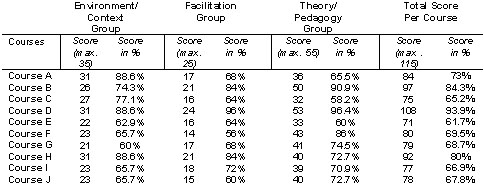
Table 1 below presents a general overview of the results per group of
characteristics. All 10 courses scored medium or better.
Table 1.
Final score of the degree of presence for the 3 sets of constructivist
characteristics for each course
 |
It is important to remind the reader that these scores show the degree of presence of constructivist characteristics. We have to acknowledge that not all of my courses have been designed with a constructivist pedagogical framework in mind; therefore, some courses may score low because they were not built using a constructivist framework. Other pedagogical frameworks may even be in conflict with the constructivism framework. The purpose of the pilot was to test the functionality of the rubric: not evaluate my courses.
The following three sections provide a closer examination of the results
for each characteristic in each group: environment/context, facilitation,
and theory/pedagogy. We will look at the group results and individual
results.
The Environment/Context Characteristics
This cluster of characteristics refers to the context of learning and the type of environment (surrounding conditions and influences) where learning occurred.
Figure 1 provides the total score for the degree of presence for each of the seven characteristics for my 10 courses. Table 2 below provides the statistical distribution for each characteristic.
Figure 1.
Total Score for the Degree of Presence for Each Environment/Context
Characteristic
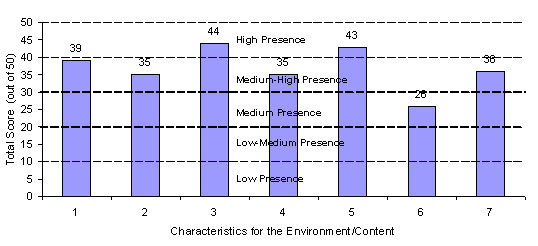 |
Table 2.
Statistical Distribution for the Degree of Presence for each Environment/Context
Characteristic
|
|
Description of Characteristics |
Mean |
Median |
Mode |
Range |
|
1 |
Learning situations, environments, skills, content and tasks are relevant, realistic, authentic, and represent the natural complexities of the 'real world'. |
3.9 |
4 |
3 |
2 |
|
2 |
Knowledge complexity is reflected in an emphasis on conceptual interrelatedness and interdisciplinary learning. |
3.5 |
4 |
4 |
3 |
|
3 |
Knowledge construction and not reproduction is emphasized. |
4.4 |
4 |
4 |
1 |
|
4 |
Assessment is authentic and interwoven with teaching. |
3.5 |
3.5 |
3, 4 |
3 |
|
5 |
Primary sources of data are used in order to ensure authenticity and real-world complexity. |
4.3 |
4.5 |
5 |
2 |
|
6 |
Goals and objectives are derived by the student or in negotiation with the teacher or system. |
2.6 |
2.5 |
2 |
2 |
|
7 |
Multiple perspectives and representations of concepts and content are presented and encouraged. |
3.6 |
3 |
3 |
2 |
The mean represents the average score of the degree of presence for each
characteristic for the 10 courses. The range represents the high and low
scores between courses. For example, a range of 1 shows that the results
were very close to each other; a range of 4 shows a much larger difference
between courses.
Most of the characteristics scored fairly well. Characteristic # 6 caught
my attention with the lowest result for degree of presence. The mode is
2. The range is 2 - not too much difference between courses. The middle
score is 2.5 and the mean is 2.6. It was also interesting to note characteristic
# 3. The range is 1 which reveals there was not a big difference between
the degrees of presence across the courses.
Degree of presence for each characteristic
Next, I will describe each characteristic and its degree of presence followed by (1) a description of my understanding of the characteristic in relation to the constructivist pedagogical framework, (2) an evaluation of the quality of the characteristic as a good assessment item, and (3) suggested improvements.
|
Characteristic # 1 |
Learning situations, environments, skills, content and tasks are relevant, realistic, authentic, and represent the natural complexities of the 'real world'. |
The average score is 3.9 over 5, or 78%.
10 courses scored ³ 3
This characteristic refers to the notion that everything related to learning has to be 'real' rather then a reproduction or representation. It is basically something you would be doing in the 'real world'. It can be a learning situation, an activity, a task that makes sense, or a task that is relevant to your own 'real' situation.
Is this characteristic a good assessment item?
- I found this characteristic easy to understand.
- I found this characteristic hard to evaluate because it is very general and difficult to measure.
- I suggest keeping the characteristic with some minor revisions, and
to add descriptive examples that would help the visualisation of its
application.
|
Characteristic # 2 |
Knowledge complexity is reflected in an emphasis on conceptual interrelatedness and interdisciplinary learning. |
The average score is 3.5 over 5, or 70%.
7 courses scored ³ 3
3 courses scored < 3
This characteristic refers to the notion that knowledge is a complex thing with many layers. To help with the complexity of knowledge, layers of learning must be linked together across disciplines. The emphasis is on the linking (such as with the Internet and its hyper linking capability).
Is this characteristic a good assessment item?
- I found this characteristic generally easy to understand.
- The terms did contain complex ideas.
- I suggest to keep it as is and to add descriptive examples of its
application.
|
Characteristic # 3 |
Knowledge construction and not reproduction is emphasized. |
The average score is 4.4 over 5, or 88%.
10 courses scored ³ 3
Knowledge construction means the learner constructs his or her knowledge as s/he learns articulating ideas and concepts in his or her own terms.
Is this characteristic a good assessment item?
- The characteristic is easy to understand but, contains complex ideas.
- It is difficult to assess because the word 'emphasized' is hard to quantify.
- I suggest to keep it as is, and to add descriptive examples of its
application.
|
Characteristic # 4 |
Assessment is authentic and interwoven with teaching. |
The average score is 3.5 over 5, or 70%.
8 courses scored ³ 3
2 courses scored < 3
Authentic means real, true, and meaningful but also, I think it means that it has to fit with the learning that occurred. If we are to use a constructivist approach to teaching, then the assessments need to reflect that approach as well. Assessment should also be interwoven with the learning process. To me this means the assessment should be part of the learning process and not an aside (stand alone) independent of the learning. Assessment should be related to the task.
Is this characteristic a good assessment item?
- I found this characteristic generally easy to understand.
- I found it hard to decide if an assessment was authentic or not maybe because I did not have a good understanding of the word 'authentic' when I started. The word 'authentic' may mean different things to different people.
- I suggest to keep it as is, and to add descriptive examples of its
application.
|
Characteristic #5 |
Primary sources of data are used in order to ensure authenticity and real-world complexity. |
The average score is 4.3 over 5, or 86%.
10 courses scored ³ 3
My understanding of this characteristic is that the data we use to learn from should come from a primary source.
Wikipedia (the free encyclopedia) suggests that "what distinguishes a primary source from a secondary source is how it is used more than what it actually contains as content." (para. 2)
The University of California Santa Cruz Library Web site explains primary sources as
These are contemporary accounts of an event, written by someone who experienced or witnessed the event in question. These original documents (i.e., they are not about another document or account) are often diaries, letters, memoirs, journals, speeches, manuscripts, interviews and other such unpublished works. They may also include published pieces such as newspaper or magazine articles (as long as they are written soon after the fact and not as historical accounts), photographs, audio or video recordings, research reports in the natural or social sciences, or original literary or theatrical works. (Primary Sources section, para. 1)
Is this characteristic a good assessment item?
- This characteristic use clear language and is easy to understand.
- The difficulty with this characteristic was to figure out what was in fact a primary source. I think to be more helpful this characteristic included descriptors of what a primary source can possibly be in relation to what is being done.
- I suggest to keep this characteristic with some minor revisions, and
to add descriptive examples of its application.
|
Characteristic #6 |
Goals and objectives are derived by the student or in negotiation with the teacher or system. |
The average score is 2.6 over 5, or 52%.
5 courses scored ³ 3
5 courses scored < 3
My understanding of this characteristic means that (1) the goals and objectives would come from the student or (2) the goals and objectives would come from negotiation with the teacher. I also understand this to mean that the content may not be necessarily negotiable but the way to learn this content may be more negotiable.
Boomer (1992) suggested that, "negotiating the curriculum means
deliberately planning to invite students to contribute, and to modify,
the educational program, so that they will have a real investment both
in the learning journey and the outcomes. Negotiation also means making
explicit, and then confronting, the constraints of the learning context
and the non-negotiable requirements that apply. (p. 14, as quoted in Gray,
1997, Constructivist Teaching Involves Negotiation section, para. 2)"
So, I see (2) as being much more applicable.
Is this characteristic a good assessment item?
- I found the terminology clear to understand; however, I still think this characteristic needs to be reworked.
- I found it difficult to assess, probably because I saw little presence of it. I think it is a good item to assess as it may show students' involvement. It needs to be more defined. For example, who are the students? (elementary student, graduate student, general population), and what kind of learning are we talking about? It needs more description.
- I suggest to keep it as is, and to add descriptive examples of its
application.
|
Characteristic #7 |
Multiple perspectives and representations of concepts and content are presented and encouraged. |
The average score is 3.6 over 5, or 72%.
10 courses scored ³ 3
I see this characteristic as a more general pedagogical framework toward learning. It can be interpreted by (1) the content presented with or through various media or (2) the presentation and interpretation of various points of view.
Is this characteristic a good assessment item?
- I found the terminology generally easy to understand.
- I found this characteristic difficult to assess because it is very general. There are too many variables to assess at the same time like multiple perspectives or multiple representations of concepts and content.
- I think different people may interpret it differently.
- I suggest to keep it with some minor revisions, and to add descriptive
examples of its application.
The Facilitation Characteristics
The Facilitation Characteristics refer to the teacher's role, skills, and strategies used to support a constructivist learning approach. Figure 2 below provides the total score for the degree of presence for each of the five characteristics while Table 3 below provides the statistical distribution for each characteristic.
Figure 2.
Total Score for the Degree of Presence for Each Facilitation Constructivist
Characteristic
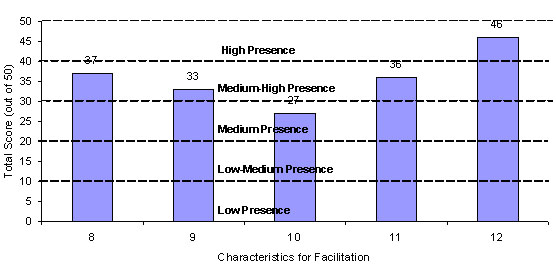 |
Table 3.
Statistical Distribution for the Degree of Presence for each Facilitation
Characteristic.
|
|
Description of Characteristics |
Mean |
Median |
Mode |
Range |
|
8 |
Teachers serve in the role of guides, monitors, coaches, tutors and facilitators. |
3.7 |
3.5 |
5 |
3 |
|
9 |
Scaffolding is facilitated to help students perform just beyond the limits of their ability. |
3.3 |
3 |
2,3 |
3 |
|
10 |
Errors provide the opportunity for insight into students' previous knowledge constructions. |
2.7 |
2.5 |
2 |
2 |
|
11 |
Teachers facilitate/promote interaction and high-level conversation through appropriate tools, media, and methods. |
3.6 |
3 |
3 |
3 |
|
12 |
Exploration is used as an approach in order to encourage students to seek knowledge independently and to manage the pursuit of their goals. |
4.6 |
5 |
5 |
2 |
Once again, most of the characteristics in this section scored well. Characteristic #10 did catch my attention with the lowest degree of presence from the group: a mode of 2, a median of 2.5 a range of 2, and a mean of 2.7.
Murphy noted that different courses might demonstrate different characteristics,
and such is the case here. Each instructor had different emphasis depending
on his/her worldview. Some instructors reinforce certain characteristics
over others: one worldview over another.
Degree of presence for each characteristic
Next, I will describe each characteristic and its degree of presence followed by (1) a description of my understanding of the characteristic in relation to the constructivist pedagogical framework, (2) an evaluation of the quality of the characteristic as a good assessment item, and (3) suggested improvements.
|
Characteristic #8 |
Teachers serve in the role of guides, monitors, coaches, tutors and facilitators. |
The average score is 3.7 over 5, or 74%.
8 courses scored ³ 3
2 courses scored < 3
The role of the teacher under this pedagogical framework is as a facilitator of knowledge rather than a transmitter of knowledge. As 'a sage on the stage', s/he guides, coaches, monitors, and/or tutors the learners. This pedagogical framework suggests a higher instructor presence.
Is this characteristic a good assessment item?
- I found the terminology easy to understand.
- I think different people may interpret it differently. It may be useful to have descriptors of the role of a guide, monitor, coach, tutor, or facilitator.
- I suggest to keep it as is, and to add descriptive examples of its
application.
|
Characteristic #9 |
Scaffolding is facilitated to help students perform just beyond the limits of their ability. |
The average score is 3.3 over 5, or 66%.
7 courses scored ³ 3
3 courses scored < 3
Scaffolding is a bit difficult to understand. In my research, I could not find a clear definition in relation to learning. The definition that resonates with me comes from Vygotsky ZPD: zone of proximal development where "the range of skill that can be developed with adult guidance or peer collaboration exceeds what can be attained alone" (Kearsley, 1994-2005, Social Development Theory section, para. 2). It is like a structure provided for on-demand help, as and when it is needed e.g. 'just on time' help.
Berge & Collins (1996) in their article Facilitating Interaction in Computer Mediated Online Courses suggest that "scaffolding for students interaction and meaning-making activities must be provided by the online instructor by modeling appropriate interaction and facilitation techniques on screen, and by providing metaphors and analogies to personalize and humanize the transactional space." (Synchronous and Asynchronous Interaction section, para. 4)
I also like McKenzie's (1999) justification of why scaffolding is important.
"[We need] to organize and support the student investigation or inquiry,
to keep students from straying too far off the path while seeking 'the
truth' about whatever issue… ." (para. 2)
Is this characteristic a good assessment item?
- I find the words "scaffolding is facilitated" difficult to clearly define.
- I found this was a difficult characteristic to assess probably because at the time I did not have a good understanding of what scaffolding meant. It is more like a strategy to use during your teaching.
- I suggest to keep it as is, and to add descriptive examples of its
application.
|
Characteristic #10 |
Errors provide the opportunity for insight into students' previous knowledge constructions. |
The average score is 2.7 over 5, or 54%.
5 courses scored ³ 3
5 courses scored < 3
This characteristic means accesses prior student knowledge but with a different twist. The instructor analyzes student error to understand how they made the mistake.
Is this characteristic a good assessment item?
- This characteristic is difficult to understand, and difficult to assess.
- The meaning is not clear.
- I suggest to keep it with some revision, and to add descriptive examples
that would help the visualisation of its application.
|
Characteristic #11 |
Teachers facilitate/promote interaction and high-level conversation through appropriate tools, media, and methods. |
The average score is 3.6 over 5, or 72%.
9 courses scored ³ 3
1 course scored < 3
II understand this to mean that the instructor is actively involved and engaged in conversations with the proper use of tools, types of media, and methods to promote high-level learning.
Is this characteristic a good assessment item?
- The language is generally easy to understand.
- There are too many variables to assess at the same time. It is too general to be tested easily. What does "appropriate" mean? It may mean different things to different people.
- I suggest to keep it with some minor revisions, and to add descriptive
examples of its application.
|
Characteristic #12 |
Exploration is used as an approach in order to encourage students to seek knowledge independently and to manage the pursuit of their goals. |
The average score is 4.6 over 5, or 92%.
10 courses scored ³ 3
Exploration was used as a strategy. This characteristic was found mostly in the discussion board activities.
Is this characteristic a good assessment item?
- The language is easy to understand.
- The word "exploration" may need a better definition and description. What is considered to be explorative learning?
- I suggest to keep it with some minor revisions, and to add descriptive
examples of its application.
The Theory/ Pedagogy Characteristics
The Theory/Pedagogy Characteristics are related to learning theory and pedagogy. The characteristics are grouped under three main headings: cognitive, social/cultural, and language/conversational. The first heading represents characteristics that are related to cognitive learning, the second represents characteristics that are related to social and cultural learning, and the last heading represents characteristics that are related to language and conversational learning.
Figure 3 provides the total score for the degree of presence for each
of the 11 characteristics. Table 4 provides the statistical distribution
for each characteristic.
Total Score for the Degree of Presence for Each Theory/Pedagogy Constructivist Characteristic
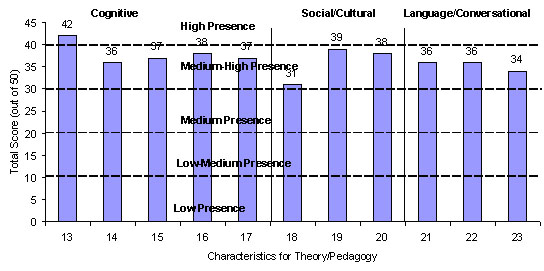 |
Table 4.
Statistical Distribution for the Degree of Presence for each Theory/Pedagogy
Characteristic.
|
|
Description of Characteristics |
Mean |
Median |
Mode |
Range |
|
|
Cognitive |
|
|
|
|
|
13 |
The student plays a central role in mediating and controlling learning. |
4.2 |
4 |
4,5 |
2 |
|
14 |
The learner's previous knowledge constructions, beliefs and attitudes are considered in the knowledge construction process. |
3.6 |
4 |
4 |
3 |
|
15 |
Problem-solving, higher-order thinking skills and deep understanding are emphasized. |
3.7 |
3.5 |
3 |
2 |
|
16 |
Activities, opportunities, tools and environments are provided to encourage meta-cognition, self-analysis -regulation, -reflection & -awareness. |
3.8 |
4 |
5 |
3 |
|
17 |
This knowledge construction takes place in individual contexts. |
3.7 |
4 |
4 |
3 |
|
|
Social/Cultural |
|
|
|
|
|
18 |
Learners are provided with the opportunity for apprenticeship learning in which there is an increasing complexity of tasks, skills and knowledge acquisition. |
3.1 |
3 |
2 |
3 |
|
19 |
Collaborative and cooperative learning are used in order to expose the learner to alternative viewpoints. |
3.9 |
4 |
5 |
3 |
|
20 |
Learners build learning communities and are active participants in knowledge construction. |
3.8 |
4 |
4 |
3 |
|
|
Language/Conversational |
|
|
|
|
|
21 |
This knowledge construction takes place through active dialog, social negotiation, collaboration and experience. |
3.6 |
4 |
4 |
4 |
|
22 |
3. The conversation supports the negotiation and creation of meaning and understanding (meaning making and interpretation) |
3.6 |
3.5 |
3 |
2 |
|
23 |
The conversation supports inherent/intrinsic opportunities for articulation (argumentation, discussion, and defence of position) |
3.4 |
3.5 |
5 |
4 |
In this last section, all characteristics scored well. All characteristics indicated at least a medium degree of presence. The cognitive section showed higher results suggesting a higher presence. This makes sense because both constructivist and cognitive approaches would likely have a focus on cognitive learning. In the social/cultural category, the results vary. The language/conversational section is interesting because of the large discrepancy between courses: with ranges of 4 for characteristics #21 and #23. This means there is quite a big difference between the degrees of presence of these characteristics across the courses.
Characteristic #18 also caught my attention with the lowest score in this group: a mode of 2, a range of 3. This means there is some discrepancy across the courses.
Degree of presence for each subset of characteristics
Next, I will describe each characteristic and its degree of presence
followed by (1) a description of my understanding of the characteristic
in relation to the constructivist pedagogical framework, (2) an evaluation
of the quality of the characteristic as a good assessment item, and (3)
suggested improvements.
Cognitive
The following five characteristics have been put under the cognitive umbrella because they appeared more related to cognition. They are representative of cognitive learning, or rather, learning seems to be happening as a mental process where learners are key players in their knowledge construction.
|
Characteristic #13 |
The student plays a central role in mediating and controlling learning. |
The average score is 4.2 over 5, or 84%.
10 courses scored ³ 3
This characteristic refers to the role of student in a constructivist framework. The instructor needs to let go of control and allow students to take charge of their learning. The student needs to take responsibility for leadership in class as they play a central role in learning.
Is this characteristic a good assessment item?
- The language is easy to understand, however, it includes complex ideas.
- I found this characteristic hard to evaluate because it is very general and difficult to measure.
- I suggest to keep it with some revision, and to add descriptive examples
of its application.
|
Characteristic #14 |
The learner's previous knowledge constructions, beliefs and attitudes are considered in the knowledge construction process. |
The average score is 3.6 over 5, or 72%.
9 courses scored ³ 3
1 course scored < 3
This characteristic is reminiscent of Bruner's curriculum spiral where you build on what you know. Ideally, we want to build on what the learner knows. When the learner learns new information s/he can make links with his or her prior knowledge to connect to new information, thereby, helping to create new knowledge.
Is this characteristic a good assessment item?
- The language is easy to understand. The meaning is clear.
- I think it's an important item to assess and to implement.
- I suggest to keep it as is, and to add descriptive examples of its
application.
|
Characteristic #15 |
Problem-solving, higher-order thinking skills and deep understanding are emphasized. |
The average score is 3.7 over 5, or 74%.
10 courses scored ³ 3
My understanding of this characteristic means that deep understanding and higher-order thinking skills are emphasized. For example, the activities and general structure of learning would require higher-order thinking skills rather than surface thinking: similar to Bloom's taxonomy and its various level.
Is this characteristic a good assessment item?
- The characteristic is easy to understand.
- It can only be assessed generally because of the general ideas.
- I suggest to keep it as is, and to add descriptive examples of its
application.
|
Characteristic #16 |
Activities, opportunities, tools and environments are provided to encourage meta-cognition, self-analysis -regulation, -reflection & -awareness. |
The average score is 3.8 over 5, or 76%.
8 courses scored ³ 3
2 courses scored < 3
The learning experiences chosen encourage a look within the self. It puts the power in the hands of the students. The instructor selects activities that promote reflection, and/or involvement in one's learning.
Is this characteristic a good assessment item?
- The language is easy to understand but contains complex ideas.
- There are too many variables to assess. It can only be assessed generally.
- I suggest to keep it with some minor revisions, and to add descriptive
examples of its application.
|
Characteristic #17 |
This knowledge construction takes place in individual contexts. |
The average score is 3.7 over 5, or 74%.
9 courses scored ³ 3
1 course scored < 3
During my program, in most courses there was a general mix of individual work and group work. This particular characteristic focuses more on the learning by oneself rather than within a group.
Is this characteristic a good assessment item?
- It is easy to understand the language.
- I'm not sure if it is very useful, It may need to focus more on the purpose of working in an individual context.
- I suggest to keep it with some revisions, and to add descriptive examples
of its application.
Social/Cultural
"Without the support and participation of a learning community, there is no online course" (Palloff & Pratt, 1999, p. 29)
The next three characteristics are related to the social and cultural
aspects of learning.
|
Characteristic #18 |
Learners are provided with the opportunity for apprenticeship learning in which there is an increasing complexity of tasks, skills and knowledge acquisition. |
The average score is 3.1 over 5, or 62%.
6 courses scored ³ 3
4 courses scored < 3
For me, this characteristic means learners have the chance to learn with experts. It is like learning by doing, at your pace, with the feedback of an expert. The sequence for learning is organized from easy to complex tasks to facilitate the progression of understanding the topic or performing the required skill.
For Seitz (1999), "traditional apprenticeships have three primary components - modeling, coaching, and fading - utilized as the master craftsman models real world activities in a sequence geared to fit the apprentice's level of ability" (Cognitive Apprenticeship as Constructivist Instructional Method section, para. 1).
Gottlieb (2000) proposes that to apply cognitive apprenticeship online there are three steps involved:
- Identify the processes of the task and make them "visible" in some manner to the learners.
- Situate abstract tasks in authentic contexts, so that learners understand the relevance of the work and how it will be directly applied to what they do.
- Vary the diversity of situations and articulate the common aspects so that learners can transfer what they learn.
Is this characteristic a good assessment item?
- The language is easy to understand, but ideas are complex.
- The words "apprenticeship learning" need to be better defined as different people may have a different understanding.
- There are too many variables.
- I suggest to keep it with some revisions, and to add descriptive examples
of its application.
|
Characteristic #19 |
Collaborative and cooperative learning are used in order to expose the learner to alternative viewpoints. |
The average score is 3.9 over 5, or 78%.
8 courses scored ³ 3
2 courses scored < 3
The assumption is that learning is not done in isolation. Learning collaboratively or cooperatively exposes learners to other points of view, therefore, increasing knowledge construction. It sounds like a strategy to create a certain outcome.
Is this characteristic a good assessment item?
- This characteristic has clear language, and is easy to understand.
- It is very specific, to the point, although "collaborative and cooperative learning" sound pretty vague.
- I suggest to keep it as is, and to add descriptive examples of its
application.
|
Characteristic #20 |
Learners build learning communities and are active participants in knowledge construction. |
The average score is 3.8 over 5, or 76%.
9 courses scored ³ 3
1 course scored < 3
The vision I have for this characteristic is basically the ideal situation. The learners are in charge of their own learning. They are actively involved, sharing 'significant' information, and supporting each other in the learning process.
Is this characteristic a good assessment item?
- I found the language easy to understand; however, the ideas are complex and difficult to assess.
- It may be useful to have descriptors of a successful learning community and what an "active participant" looks like. This characteristic can only be assessed very generally because of its general nature.
- I suggest to keep it as is, and to add descriptive examples of its
application.
Language/Conversational
The next three characteristics are related to the language and conversational aspects of learning.
|
Characteristic #21 |
This knowledge construction takes place through active dialog, social negotiation, collaboration and experience. |
The average score is 3.6 over 5, or 72%.
7 courses scored ³ 3
3 courses scored < 3
Learning construction happens through active dialogue during social negotiation of meaning and experience. This means that learning occurs with some type of involvement with others.
During my program, in most courses there was a general mix of individual
work and group work. This particular characteristic focuses more on the
learning (knowledge construction) that occurs as part of an active group
rather than solitary study.
Is this characteristic a good assessment item?
- The language is clear language, but it contains complex ideas.
- I found the terminology easy to understand; however, I think different people may interpret it differently. It may be useful to have descriptors of "active dialog, social negotiation, collaboration, and experience". It is difficult to evaluate because there are too many things to assess.
- I suggest to keep it as is, and to add descriptive examples of its
application.
|
Characteristic #22 |
The conversation supports the negotiation and creation of meaning and understanding (meaning making and interpretation) |
The average score is 3.6 over 5, or 72%.
10 courses scored ³ 3
My understanding of the characteristic means that while we are actively involved (characteristic 20), the conversation in the virtual world helps create new understanding. For example, in one of my courses we had weekly exercises as well as dialogues that helped us create new understanding. The conversation helped us develop new meaning. By sharing our exercises we shared different points of views and differing perspectives on the topic.
Is this characteristic a good assessment item?
- The language easy to understand.
- The meaning is clear but complex to assess. It seems to be limited mostly to online discussion.
- I suggest to keep it as is, and to add descriptive examples of its
application.
|
Characteristic #23 |
The conversation supports inherent/intrinsic opportunities for articulation (argumentation, discussion, and defence of position) |
The average score is 3.4 over 5, or 68%.
7 courses scored ³ 3
3 courses scored < 3
My vision of this characteristic assumes that there is already a conversation going on and that this conversation purposely provides opportunities (it is planned) for higher level of discussion. The conversation provides opportunities to express yourself, to share knowledge, to argue positions, etc.
Is this characteristic a good assessment item?
- The language is easy to understand, but it contains complex ideas.
- There are many variables to assess (articulation, discussion, argumentation and defence of position). It seems to be limited mostly to online discussion.
- I suggest to keep this characteristic with some minor revisions, and
to add descriptive examples of its application.
The next section is a summary of the results for each characteristic
in my 10 courses.
Table 5 is a summary of the results, which demonstrate the general level
of presence for each characteristic.
It is interesting to see that most of the characteristics scored fairly
well in most courses. There are three characteristics (#6, #10 and #18)
that stand out more than the others. Four to five courses did not show
a high level of presence for characteristics #6, #10 and #18.
Once again, I must remind the reader the limitation of this study. Not
all courses were designed with a constructivist framework; therefore,
the results do not hold as much value. Nevertheless, this testing of the
rubric has helped me understand each characteristic much better, and therefore,
increased my knowledge of constructivist principles and characteristics.
Now, I feel more knowledgeable about constructivism and some of its application.
Summary results for my 10 courses
| Characteristics List |
Mean (for 10 courses) |
Courses That |
Courses That |
|
|
1 |
Learning situations, environments, skills, content and tasks are relevant, realistic, authentic, and represent the natural complexities of the 'real world'. |
3.9 |
10 |
0 |
|
2 |
Knowledge complexity is reflected in an emphasis on conceptual interrelatedness and interdisciplinary learning. |
3.5 |
7 |
3 |
|
3 |
Knowledge construction and not reproduction is emphasized. |
4.4 |
10 |
0 |
|
4 |
Assessment is authentic and interwoven with teaching. |
3.5 |
8 |
2 |
|
5 |
Primary sources of data are used in order to ensure authenticity and real-world complexity. |
4.3 |
10 |
0 |
|
6 |
Goals and objectives are derived by the student or in negotiation with the teacher or system. |
2.6 |
5 |
5 |
|
7 |
Multiple perspectives and representations of concepts and content are presented and encouraged. |
3.6 |
10 |
0 |
|
8 |
Teachers serve in the role of guides, monitors, coaches, tutors and facilitators. |
3.7 |
8 |
2 |
|
9 |
Scaffolding is facilitated to help students perform just beyond the limits of their ability. |
3.3 |
7 |
3 |
|
10 |
Errors provide the opportunity for insight into students' previous knowledge constructions. |
2.7 |
5 |
5 |
|
11 |
Teachers facilitate/promote interaction and high-level conversation through appropriate tools, media, and methods. |
3.6 |
9 |
1 |
|
12 |
Exploration is used as an approach in order to encourage students to seek knowledge independently and to manage the pursuit of their goals. |
4.6 |
10 |
0 |
|
13 |
The student plays a central role in mediating and controlling learning. |
4.2 |
10 |
0 |
|
14 |
The learner's previous knowledge constructions, beliefs and attitudes are considered in the knowledge construction process. |
3.6 |
9 |
1 |
|
15 |
Problem-solving, higher-order thinking skills and deep understanding are emphasized. |
3.7 |
10 |
0 |
|
16 |
Activities, opportunities, tools and environments are provided to encourage meta-cognition, self-analysis -regulation, -reflection & -awareness. |
3.8 |
8 |
2 |
|
17 |
This knowledge construction takes place in individual contexts. |
3.7 |
9 |
1 |
|
18 |
Learners are provided with the opportunity for apprenticeship learning in which there is an increasing complexity of tasks, skills and knowledge acquisition. |
3.1 |
6 |
4 |
|
19 |
Collaborative and cooperative learning are used in order to expose the learner to alternative viewpoints. |
3.9 |
8 |
2 |
|
20 |
Learners build learning communities and are active participants in knowledge construction. |
3.8 |
9 |
1 |
|
21 |
This knowledge construction takes place through active dialog, social negotiation, collaboration and experience. |
3.6 |
7 |
3 |
|
22 |
The conversation supports the negotiation and creation of meaning and understanding (meaning making and interpretation) |
3.6 |
10 |
0 |
|
23 |
The conversation supports inherent/intrinsic opportunities for articulation (argumentation, discussion, and defence of position) |
3.4 |
7 |
3 |
The next section is a discussion about results and the rubric itself.
Learning by distance is not a new concept. Teaching and learning through computer and communication technology (or online learning) is much newer.
Lately, I have become increasingly interested in the constructivist pedagogical framework as it appears to be considered a good learning theory for the virtual world (Anderson & Kanuka, 1999; Gold, 2001). This has been the focus of my inquiry.
Is constructivist pedagogy the only adequate pedagogy for online learning?
Even though constructivist learning is gaining popularity in online learning,
I would say: Absolutely not! Instructional designers must choose appropriate
pedagogy for what we are trying to achieve or accomplish. Learning theories
provide us with an organizational framework. We can choose instructional
methods and strategies based on our selected organizational framework.
The instructional implementation will look different depending on the
framework used to build lessons and courses.
Results
am not too surprised of the general results, as several of my courses were not built with a constructivist pedagogical framework. Murphy (1997) mentioned that not all the characteristics were present in each of the projects she evaluated. I found this to be true for the results in my testing of the rubric as well. For example, in the same course, some characteristics showed a higher degree of presence while others not as much. This reminds me that there are many applications of constructivism.
Let's look at the two characteristics that showed a lesser presence.
# 6 - Goals and objectives are derived by the student or in negotiation
with the teacher or system.
#10 - Errors provide the opportunity for insight into students' previous
knowledge constructions.
The lower result for characteristic #6 is mostly due to the fact that several of my courses have not been designed using constructivist pedagogy. The lower result for characteristic #10 is mostly due to the fact that this characteristic was difficult to grasp, and therefore, difficulty to assess.
The rest of the characteristics showed a medium degree of presence and higher.
Rubric
The highlight of this research is the development of the rubric and its use.
When I worked on the rubric, I regrouped characteristics by clusters I felt important to online delivery. I feel online delivery requires the following:
- an environment/context (surrounding conditions and influences) to situate the learning,
- some facilitation skills,
- and some pedagogy to guide our approach to learning.
Under the environment/context cluster, I regrouped the characteristics
that seemed to be more associated to a setting. By this, I mean the formation/creation
of a learning environment (surrounding conditions and influences) that
could help provide a constructivist context.
Under the facilitation cluster, I regrouped the characteristics that were associated with the type of facilitation (teacher's role, skills and strategies to support constructivist learning). In a sense, this makes me think of teacher presence in the Garrison et al model: although not the same characteristics. When I was coding text-based asynchronous discussions using the Garrison et al model (see research section), it became evident to my coding partner and myself that the teacher presence had an effect on the pattern of interaction seen in students' messages.
Two instructors were teaching the course together. Each instructor was
responsible for one of two groups of students during an online debate.
While coding the text-based asynchronous discussion of that specific instructional
strategy, we noticed that one instructor was more present with his/her
assigned group while the other instructor was less so. It was interesting
to note that in the group where the instructor was not as present, the
pattern of interaction among students was quite low compared to the one
where the instructor was present more often. (Kanuka, Lépine &
Larkin, 2004),
The theory/pedagogy characteristics are related to the theories of learning and pedagogy. Palloff and Pratt (1999) suggested that it is pedagogy that most influences the online learning experience. I regrouped the characteristics into three clusters: the cognitive, under the cognitive umbrella; the social/cultural; and language/conversational, under the social umbrella. The cognitive characteristics are related to the individual and learning as a mental activity. Learning is happening in the mind of the person who is learning. The social characteristics are related to learning as being a social activity where culture and language affect the learning process. Vygotsky (1978, as paraphrased in Maypole & Davies, 2001) stated that, "within social interactions, cultural meanings are shared and internalized." (Constructivist Learning Theories Defined section, para. 3) Hein (1991) is also a strong advocate of learning being a social activity. He said that, "our learning is intimately associated with our connection with other human beings, our teachers, our peers, our family as well as casual acquaintances…." (Principles of learning, para. 6). He also believes that the language we use influences our learning.
Did the rubric work well?
At the beginning, I thought that characteristic #10 might fit well under the facilitation group. I was seeing it more as the instructor's approach to appreciate students' prior knowledge. But now, I think it would fit much better under the cognitive characteristics because I see it more as cognitive pedagogy.
I thought that characteristic #18 might fit well under the social/culture cluster as I considered apprenticeship learning a social activity where one would learn from an expert. But now, I think it would fit much better under the cognitive characteristics because the learning may be more cognitive than social. (See Appendix D for revised version)
Testing each item on the rubric gave me the chance to explore each characteristic
in more detail and to get a better understanding of each characteristic.
Some characteristics were easier to assess for many different reasons.
Sometimes, it was because there were too many things to assess; other
times, the language was complex and the idea difficult to grasp. If all
the characteristics had descriptive examples to visualise their application,
that would make it much easier to get the picture! And the rubric would
probably be more useful.
The goal of this essay was to understand better what is a constructivist approach to learning. I wanted to focus on constructivist pedagogy in the virtual world. I wanted to be more knowledgeable of constructivist characteristics and principles to be better able to recognize them.
I learned a lot while doing this Exit document. I learned about the various positions of constructivism, their common similarity, and how critical or cognitive constructivism and social constructivism appear to be the most used and talked about in the literature I read. I learned that creating a rubric is not an easy task. In fact, you may need many revisions in order to get an adequate rubric. Nevertheless, producing the rubric was the highlight of this research. It was a real eye opener to build on the work of someone else and to try to improve it so I could use it in my own work. That was a very enlightening (but very long) activity!
Doing this type of analysis was good for me, as an instructional designer. It opened my eyes on the many variables that can influence learning in the virtual world. I now understand more than ever that the instructor presence in an online course is very significant. Even when a course is very well designed, if the facilitation is limited (assuming a constructivist approach to learning), the final result will likely be not as successful. The teacher's presence is important. Designing and developing online courses is like building an intricate puzzle where many pieces are needed to make it complete. It's a lot of fun!
I am not sure yet how helpful this rubric would be as a tool for design and/or for assessment. I would improve the rubric by adding descriptive examples to help visualise the application for each characteristic. That, I think would make the rubric much more useful.
APA Style. (2001). Citations in Text of Electronic Material.
Retrieved January 16, 2006 from http://www.apastyle.org/electext.html.
Berge, Z. & Collins, M. (1996). Facilitating interaction in computer mediated online courses. Retrieved Dec.10, 2004, from http://www.emoderators.com/moderators/flcc.html.
Ertmer, P.A. and Newby, T.J. (1993). Behaviorism, Cognitivism, Constructivism: Comparing critical features from an Instructional Design perspective. Performance Improvement Quarterly, 6(4), 50-72. Retrieved Dec.10, 2004, from http://www.personal.psu.edu/users/t/x/txl166/kb/theory/compar.html
Garrison, D. R., Anderson, T., & Archer, W. (2000). Critical inquiry in a text-based environment: Computer conferencing in higher education. The Internet and Higher Education, 2(2-3), 87-105. Retrieved Dec.10, 2004, from http://communitiesofinquiry.com/documents/Critical_Inquiry_model.pdf.
Gold, S. (2001). A constructivist approach to online training for online teachers. JALN, 5(1). Retrieved October 20, 2005, from http://www.aln.org/publications/jaln/v5n1/v5n1_gold.asp.
Gottlieb, M. (2000). Foundations of E-Learning. Communication Project Magazine. 3(1). Retrieved Nov 1, 2005, from http://www.comproj.com/Gottlieb.htm.
Gray, A. (1997). Constructivist Teaching and Learning. Report #97-07. Retrieved October 20, 2005, from Saskatchewan School Trustees Association Research Centre: http://www.ssta.sk.ca/research/instruction/97-07.htm.
Gredler, M. E. (2001). Learning and instruction: Theory into practice (4th ed.). Upper Saddle River, NJ: Merrill Prentice Hall.
Hein, G. (1991). Constructivist Learning Theory. Paper presentation at CECA (International Committee of Museum Educators) Conference, Jerusalem Israel, 15-22 October 1991. Retrieved August 10, 2004, from http://www.exploratorium.edu/IFI/resources/constructivistlearning.html.
Hendriks, V., (2003). From Research and Learning Theory to Designing Online Learning Environments and Activities. UNU Online Learning. Retrieved August 10, 2004, from http://www.onlinelearning.unu.edu/Resources/UNU-OL2-Application.doc.
How to … Distinguish Between Primary and Secondary Sources. (last update November 2005) University Library. University of California, Santa Cruz. Retrieved December 10, 2005 from http://library.ucsc.edu/ref/howto/primarysecondary.html.
Jonassen, D. (n. d.). Designing Constructivist Learning Environments (CLEs). Retrieved August 10, 2004, from http://tiger.coe.missouri.edu/~jonassen/courses/CLE/index.html.
Kanuka, H., and Anderson, T. (1998). On-line social interchange, discord, and knowledge construction. Journal of Distance Education, 13(1). Retrieved Jan. 12, 2005, from http://cade.athabascau.ca/vol13.1/kanuka.html
Kanuka, H., and Anderson, T. (1999). Using constructivism in technology-mediated learning: constructing order out of the chaos in the literature. Radical Pedagogy, 1(2). Retrieved August 10, 2004, from http://radicalpedagogy.icaap.org/content/issue1_2/02kanuka1_2.html.
Kanuka, H., Lépine, B., & Larkin, K. (2004). An investigation of learning strategies for higher levels of online learning. Paper presentation at the Canadian Society for Higher Education, May-June, 2004, Winnipeg, Canada.
Kearsley, G. (1994-2005). Constructivist Theory (J. Bruner). Retrieved December 10, 2005 from http://tip.psychology.org/bruner.html.
Kearsley, G. (1994-2005). Genetic Epistemology (J. Piaget). Retrieved December 10, 2005 from http://tip.psychology.org/piaget.html.
Kearsley, G. (1994-2005). Social Development Theory (L. Vygotsky).
Retrieved December 10, 2005 from http://tip.psychology.org/vygotsky.html.
Lépine B. (1999-2005). Exit Portfolio Website for Brigitte Lépine. Located at http://bri.bbwebmedia.com/portfolio/.
Lock, J. (2002). Laying the Groundwork for the Development of Learning Communities Within Online Courses. Paper presented at the Linking Research to Practice Symposium, January 2002, University of Calgary, AB, Canada. Retrieved August 10, 2004, from http://www.ucalgary.ca/~lrussell/lock.html.
Maypole, J. and Davies, T. G. (2001). Students' perceptions of constructivist learning in a community college American History II survey course. Community college review. 29(2): 54 - 79. Retrieved October 20, 2005, from http://www.findarticles.com/p/articles/mi_m0HCZ/is_2_29/ai_80344771.
McKenzie, J. (1999). Scaffolding for Success. From Now On: The Educational Journal, 9(4). Retrieved October 20, 2005, from http://www.fno.org/dec99/scaffold.html.
Mergel, B. (1998). Instructional Design and Learning Theory. Retrieved March 10, 2003 from http://www.usask.ca/education/coursework/802papers/mergel/brenda.htm.
Murphy, E. (1997). Constructivism: from philosophy to practice, Retrieved Dec.10, 2004, from http://www.stemnet.nf.ca/~elmurphy/emurphy/cle.html.
On Purpose Associates. (2003). Constructivism. Retrieved August 10, 2004, from http://www.funderstanding.com/constructivism.cfm.
Palloff, R. N., and Pratt, K. (1999). Building learning communities in cyberspace: Effective Strategies for the online classroom. San Francisco: Jossey-Bass Inc.
Prawat, R. S. (1996). Constructivisms, modern and postmodern. Educational Psychologist, 31(3/4), 215-225.
Seitz, R. (1999). Short Paper: Cognitive Apprenticeship. Retrieved Nov 7, 2005, from http://chd.gse.gmu.edu/immersion/knowledgebase/strategies/constructivism/CognitiveApprenticeship.htm.
Wikipedia contributors (2005). Primary source. Wikipedia, The Free Encyclopedia. Retrieved December 10, 2005 from http://en.wikipedia.org/w/index.php?title=Primary_source&oldid=32206754.
EDER 671—Presentation Assignment: Theories and Research in Learning and Instruction
EDER 619.08—Group Presentation for Week 5 Significant Learning Experiences: What goes into design?
EDER 677—Electronic Academic Portfolio
EDER 677—Extensive Online Resource (not completed)
Learning and Online Delivery Course Syllabus (Fall 2003)
Leadership and the Implementation of Technology in the School System (Fall 2002)
Overview of Technology Integration (Fall 2002)
Quantitative and Qualitative Research Methods (Fall 2000)
Overview
of Technology Integration (Fall 2002)
Lessons Learned: Content Analysis of Asynchronous Text Based Discussion (Summer 2004)
Learning (Winter 2003)
EDER 677—Online Collaboration & Virtual Teams
Many-to-Many Techniques in Online Asynchronous Environments (Summer 2003)
The Practice of Online Discussion in Distance Learning (Winter 2003)