| Intro |
| Chapter 1 |
| Chapter 2 |
| Chapter 3 |
| Chapter 4 |
| Activities |
| Questions |
| Resources |
| Experiences |
 |
Chapter 3 Designing Significant Learning Experiences I: Getting Started |
|
Summary This chapter (as
well as chapter 4) proposes ideas on how to design courses that
will generate ‘powerful learning experiences.’ Chapter 3 includes:
Chapter 4 will
cover the rest of the steps The author
suggest that generally there are 2 basic ways to put a course together:
—the teacher create a list of topics and
then proceed to create lectures for each topic
—the teacher takes responsibility for deciding
what constitute high-quality learning and then design that quality
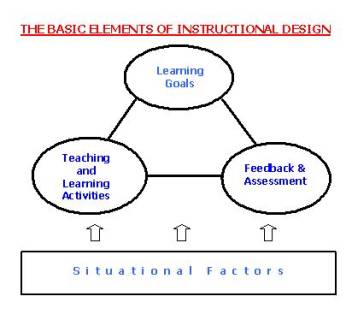
into the design A new model: Integrate course
design
The author suggest
the following model and its key components (p. 62).
Initial Design Phase: Build
Strong Primary Components Step 1. Identify
important situational factors Step 2. Identify
important learning goals Step 3. Formulate
appropriate feedback and
assessment procedures Step 1 focuses on situational factors
Step 3 focuses
on feedback and assessment The author discusses two types of assessing methods (see figure 3.5, p.83): Audit-ive Refers to an assessment procedure such as the instructor only using midterm and final types of assessments. Educative Refers to a larger variety of assessment procedures
for a more complete and rounded assessment of the learner. |
|